Stereotypes on screen
What do 3 million plot summaries, IMDb's full catalogue and TMDb's records say about how film and TV cast, write about and label women and social groups? Thirteen studies, 1920–2026.
Content note: this is about stereotypes, so it discusses them. Slurs and insulting labels are counted in the data but never shown.
The 0.95 that wasn't
In 2022, Stefano Li Pira and I trained a BERT model to spot stereotypes in plot summaries, and it scored an impressive AUC of 0.95. Its positives were long film synopses and its negatives short episode plots, though, so text length alone could tell them apart.
In 2026 I went back and rebuilt it properly, with matched comparisons and series kept whole in cross-validation. The same idea then reaches 0.71–0.76, and what it detects is stories about prejudice, not stereotyped portrayals. So I started again: 3,000 summaries labelled against a written codebook, modern open embedding models, and measures checked against those labels. Here is what came out.
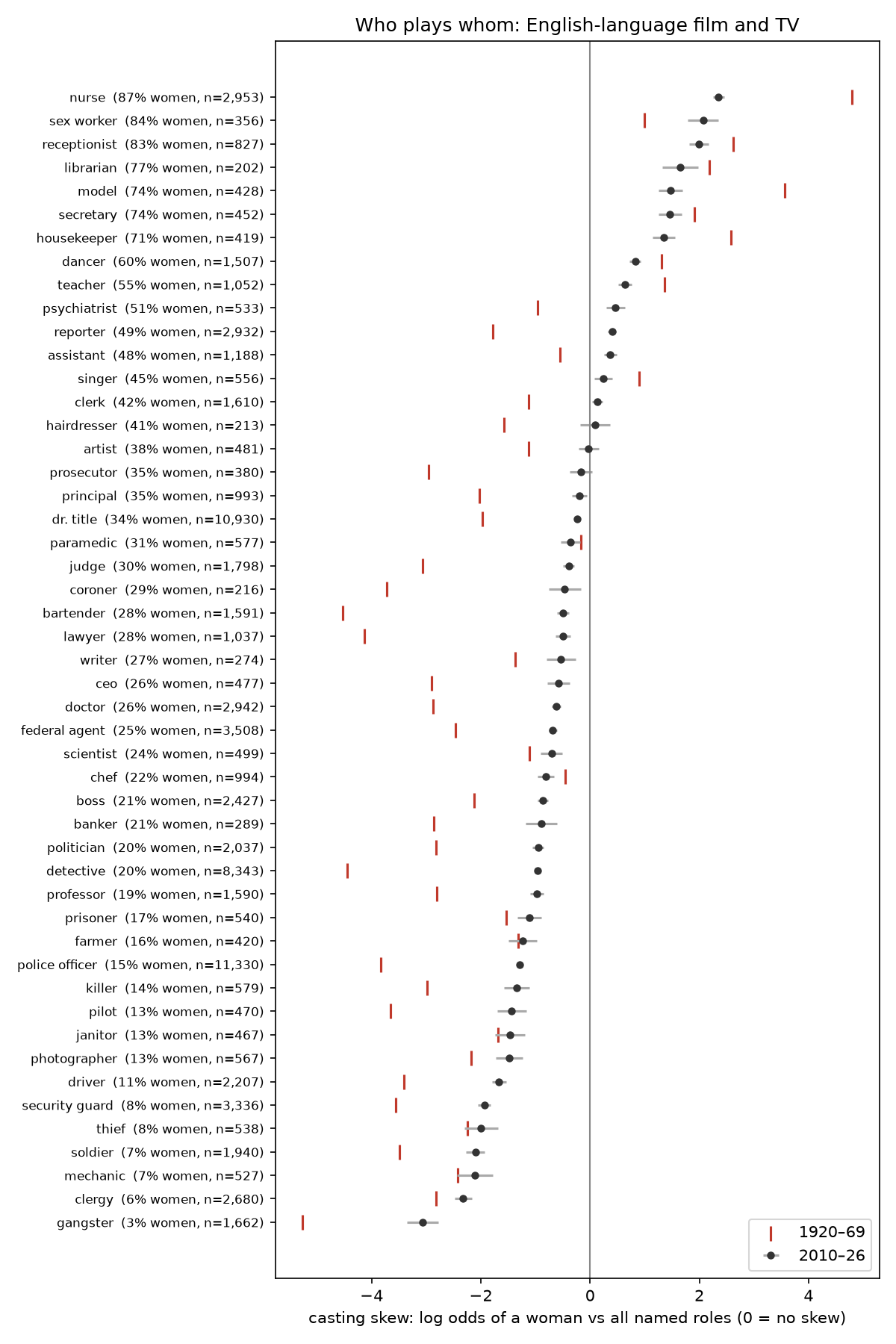
Women got the detective jobs. Men didn't get the nurse jobs.
Detectives, judges and lawyers went from almost never played by women before 1970 to 20–30% women today. Nurses, nannies and receptionists are still 83–90% women. Change came from women moving into roles coded male, not the other way round.
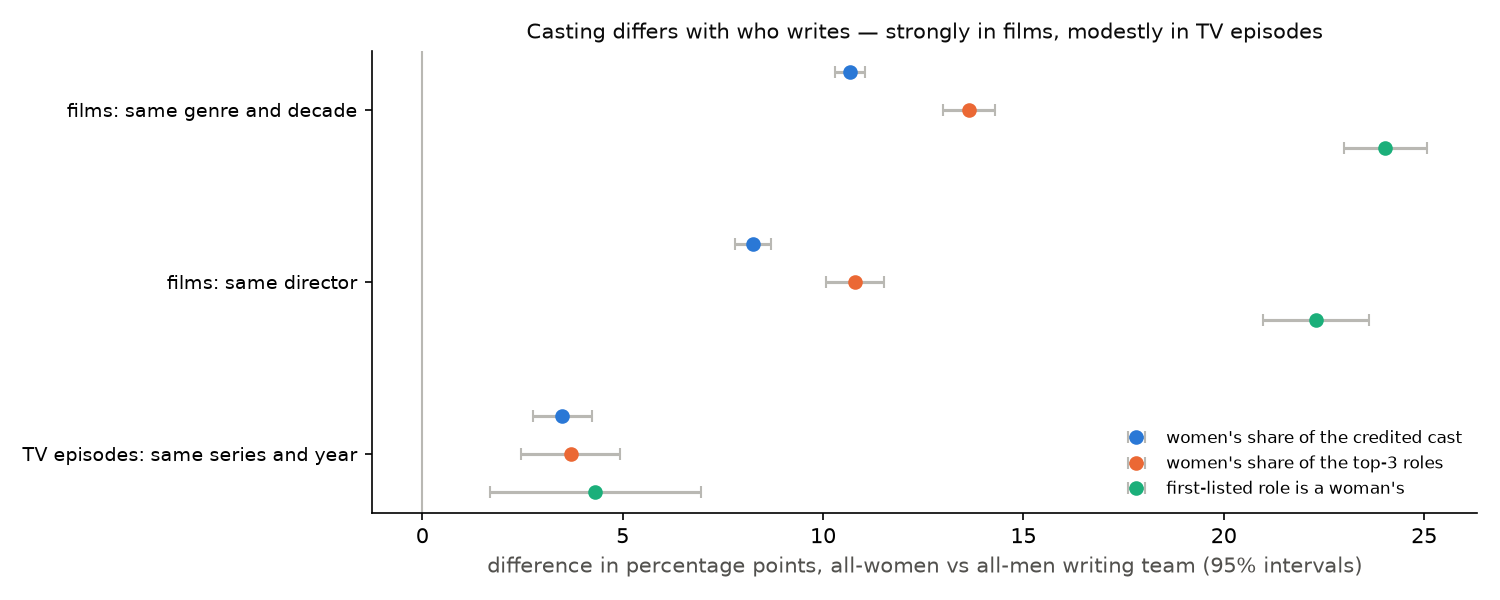
Films written by women cast more women.
Films written only by women cast 11 points more women than comparable films written only by men, and 8 points more even among the same director's films. Within a TV series the gap is about 3 points, which fits writers working inside a series' fixed cast.
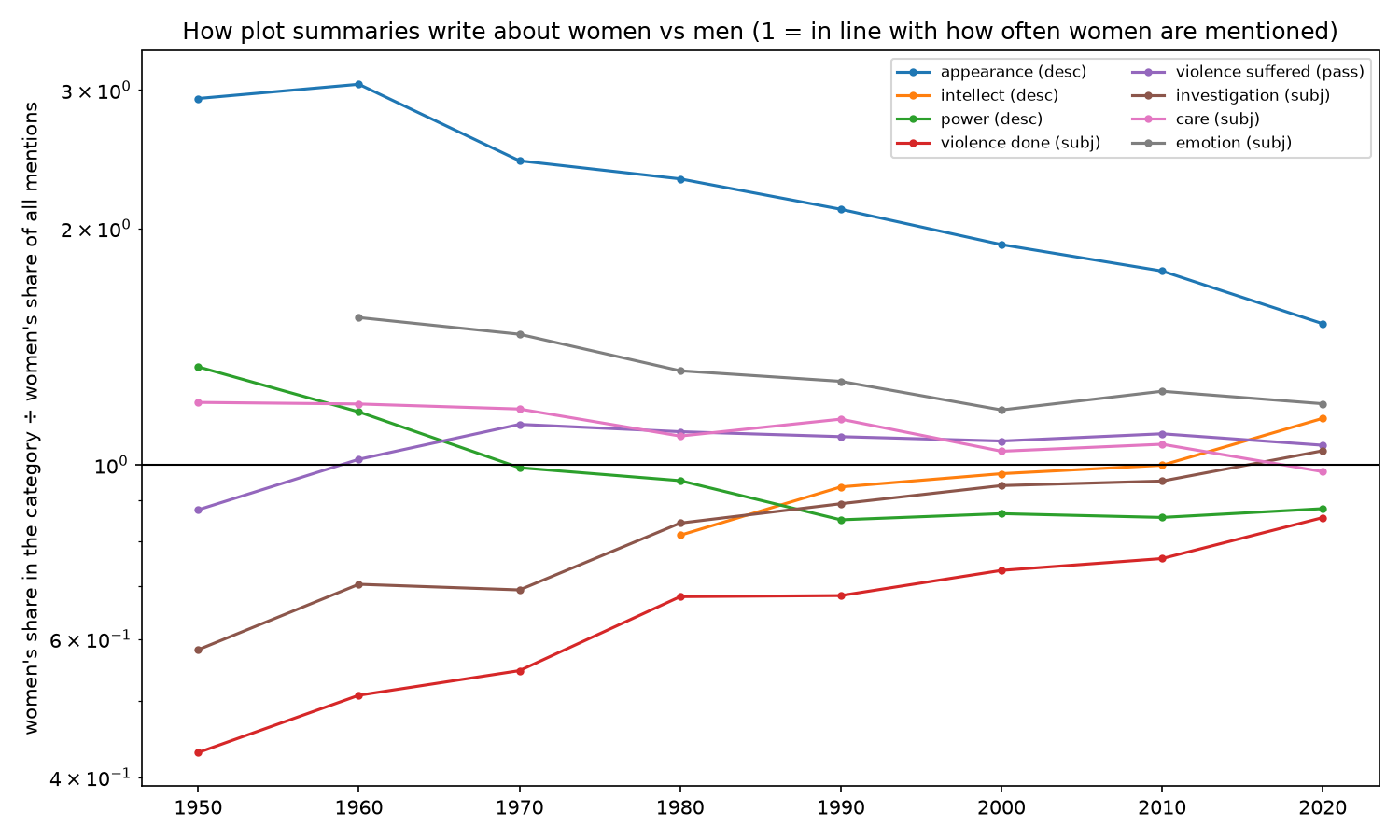
Half the characters now, still described by their looks.
Women went from 28% to 46% of the people plot summaries talk about. They are still described by their looks 1.5 times as often as their share would predict, down from 3 times in the 1950s.
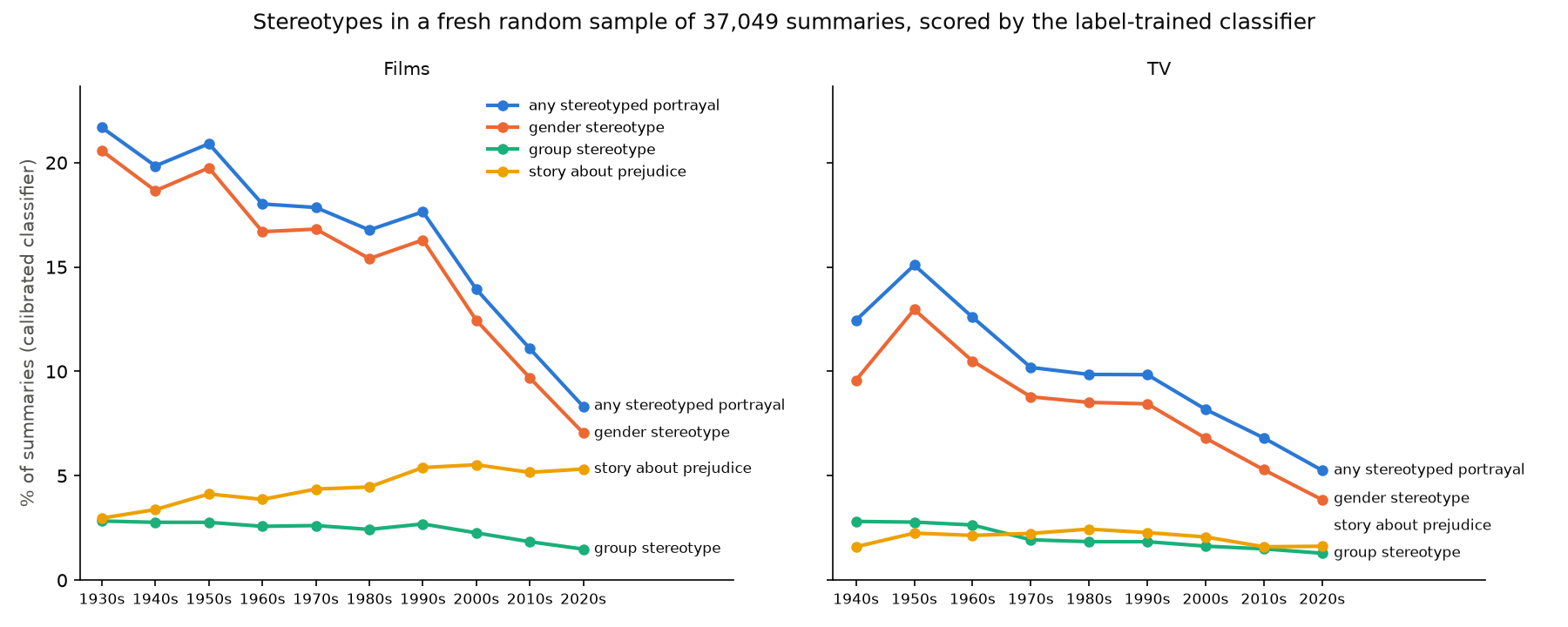
Stereotyped portrayals are fading, mostly the gendered ones.
Trained on those labels, an EmbeddingGemma-2 classifier recognises stereotyped portrayals with AUC 0.86–0.90. On 37,049 fresh summaries, film portrayals fall from 22% in the 1930s to 8% now, and on TV from 15% in the 1950s to 5%. Almost all of the fall is in gender stereotypes.
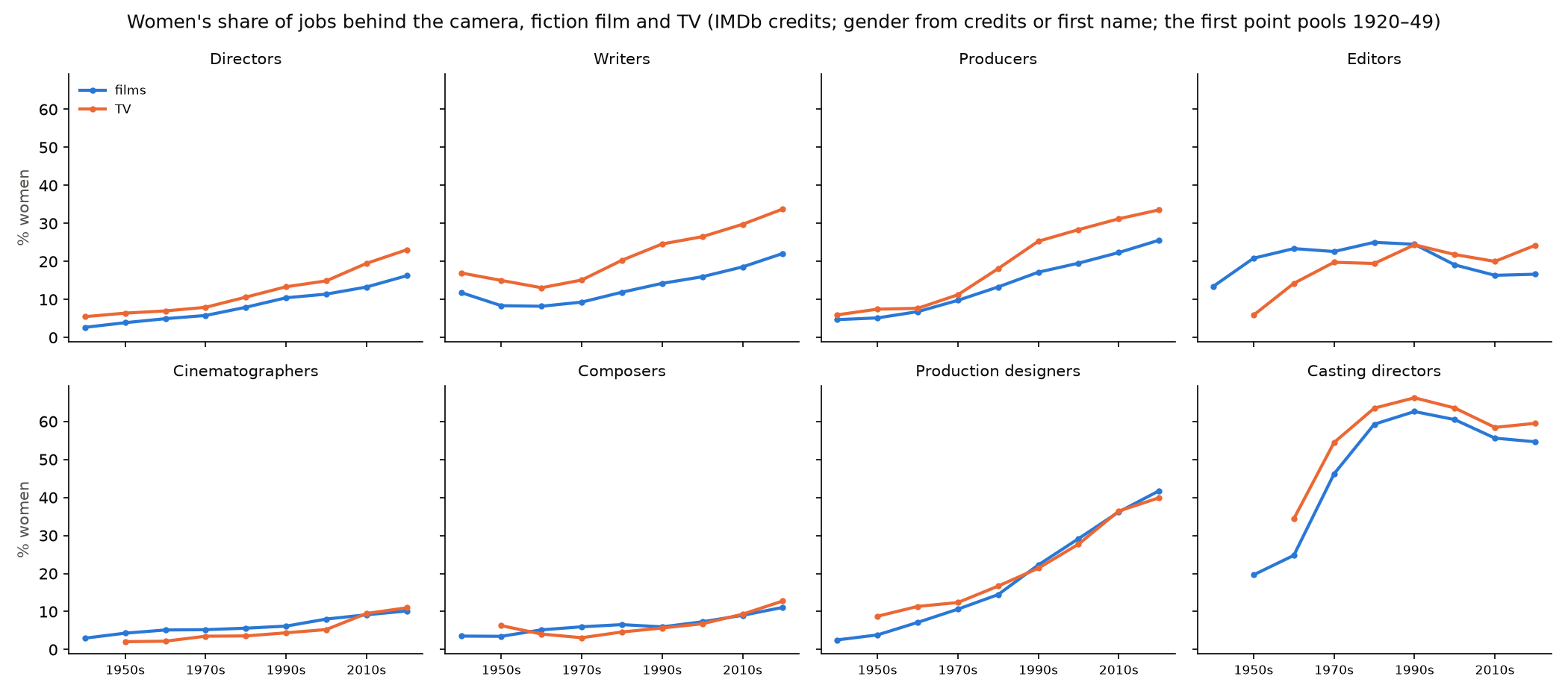
Directors: from 3% women to 16%.
Women went from 3% of film directors before 1950 to 16% in the 2020s. They still hold only 38% of first-listed film roles, and in the same film the first-listed man is about six years older than the first-listed woman.
Stereotyped films earn less.
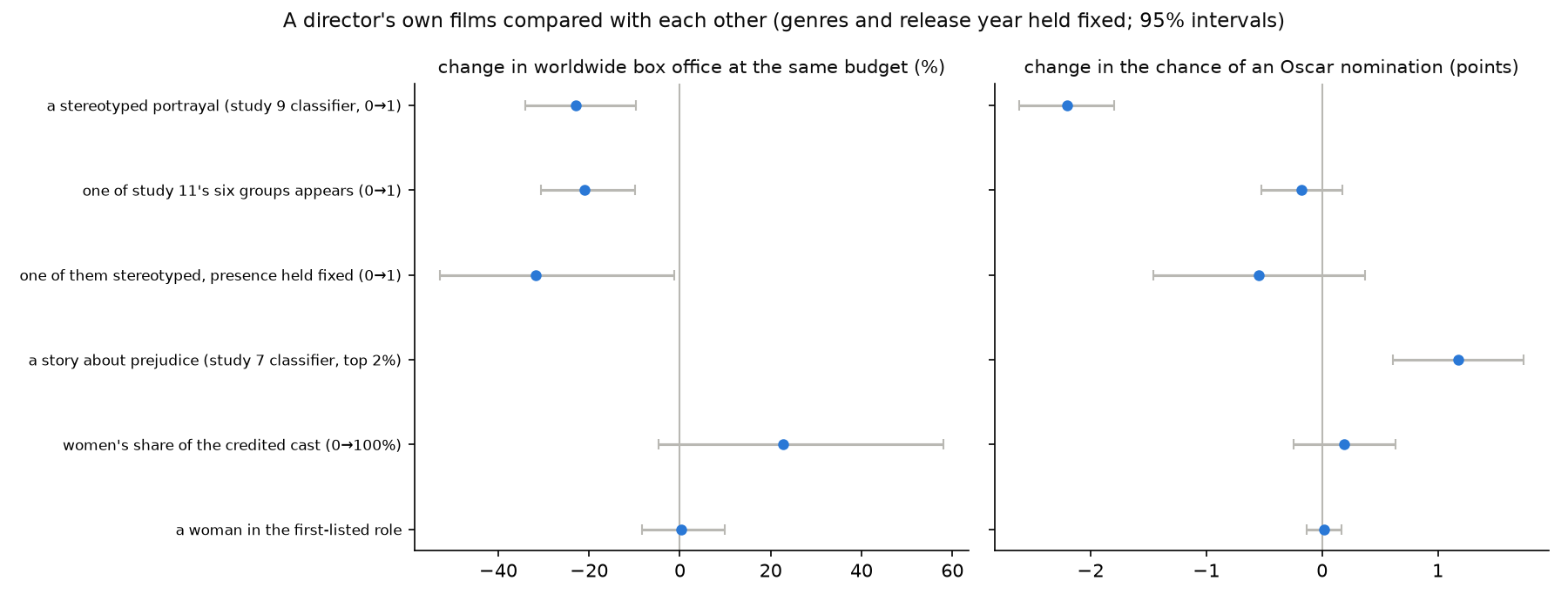
A film whose summary the classifier reads as a stereotyped portrayal takes 23% less at the box office than the same director's other films at the same budget, and is 2.2 points less likely to get an Oscar nomination (about 1 rated film in 85 gets one). Critics and audiences mark these films down alike.
Women behind the camera, fewer group stereotypes.
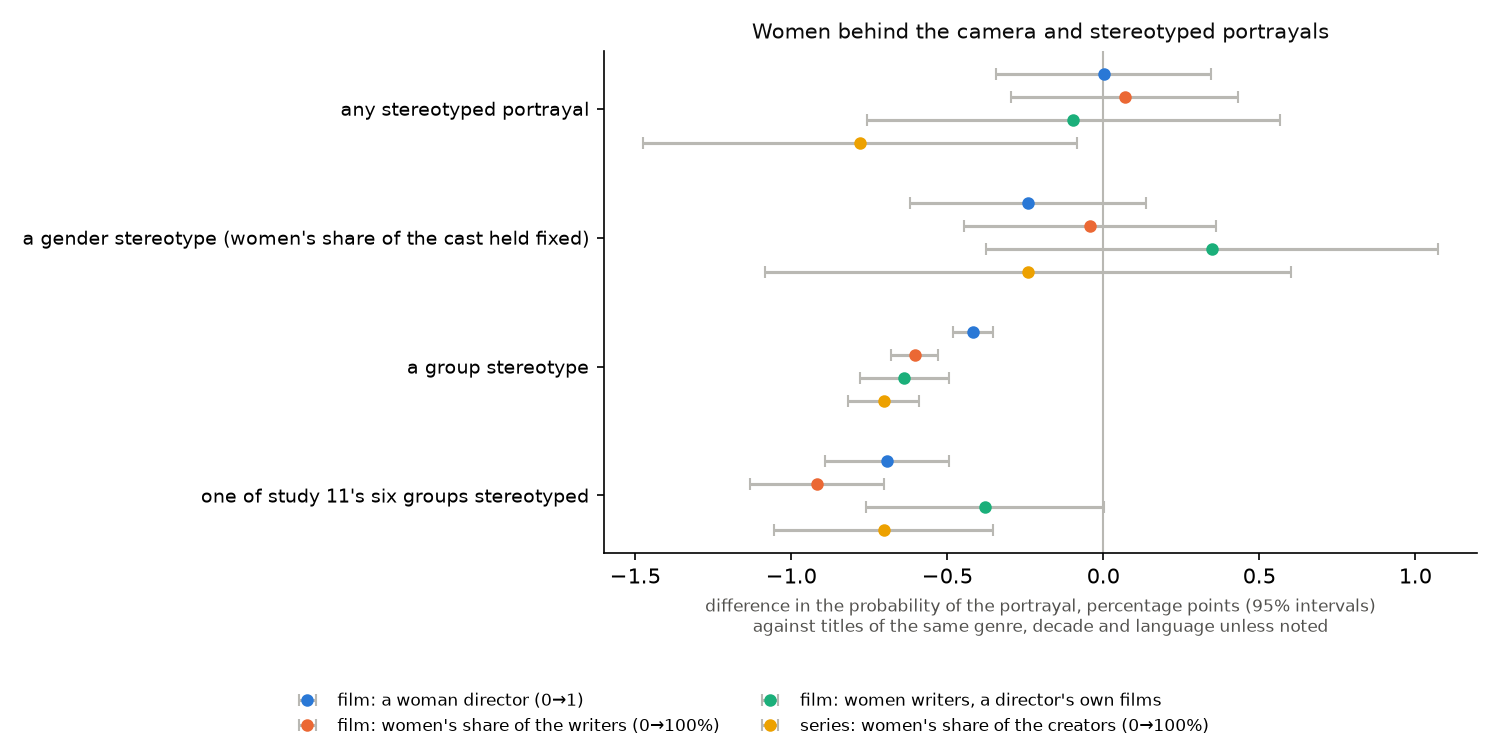
Films and series made by women contain 15–34% fewer group stereotypes in the main comparisons, and no more gender stereotypes once their casts are compared.
Some stereotypes never left.
Immigrants, disabled people, people with a mental illness, and older, poor and homeless people are stereotyped in a steady 5–6% of film summaries from the 1930s to the 2010s (4.5% in the 2020s). Unlike gender, there is no long decline.
How, and how far to trust it
IMDb's datasets, TMDb's API and Wikipedia's episode pages; parsing with spaCy, word embeddings, and classifiers on open embedding models trained on labels written to a codebook. Titles are compared within a series, a director's films, a franchise or similar films, with summary length held fixed. Only aggregates are published: no plot text, no per-title data.
These are associations, not effects. Summaries are written by contributors, not the productions. The labels come from one language model following a written codebook; a second pass by the same model agrees closely, which shows consistency, not that independent readers would agree. All thirteen studies, the code and the caveats are in the repository.
This expands Stefano Li Pira's 2022 initiative to measure stereotypes in TV series, which we first explored together.
Information courtesy of IMDb (https://www.imdb.com). Used with permission.
 This product uses the TMDB API but is not
endorsed or certified by TMDB.
Wikipedia episode summaries (CC BY-SA 4.0). Rotten Tomatoes and Metacritic scores were read from their public pages for non-commercial research. Charts: CC BY 4.0, from the repository.